

It’s almost 10 at night. Your belly is empty, but your desk is still overflowing. Just as you’re about to close your laptop, that familiar sting of “Fear Of Being Obsolete” (FOBO) kicks in. You see another headline about a new AI model, and the internal monologue starts: “Am I already falling behind? How can I hit my goals when it feels like I’m swimming against a riptide of tech trends and media scares?”
If you’ve felt like you’re running a race where the finish line keeps moving ten miles further back every time you catch your breath, grab a coffee. We need to talk about why the standard “just learn AI” advice is actually making your life harder – and how the real winners of 2026 are playing a completely different game.
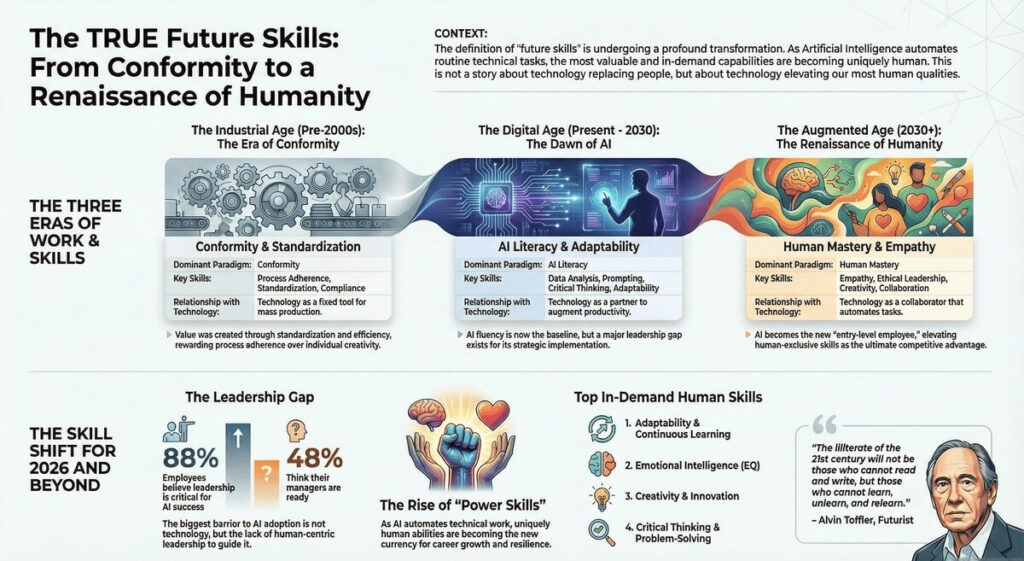
“The illiterate of the 21st century will not be those who cannot read and write, but those who cannot learn, unlearn, and relearn.”
— Alvin Toffler
The “Prompt Engineering” Trap and the ROI Gap
We’ve been sold a story that if we just master the right “magic words” to type into a chatbot, we’ll be set. But the data tells a different story. While people are enrolling in AI courses at a staggering rate of 14 per minute, nearly 95% of businesses report zero return on their AI investments. Why? Because most are treating AI like a new piece of software to learn, rather than a fundamental shift in how we think.
The “technical” side of AI is becoming easier and more automated by the day. If your only value is knowing which button to click, you’re at risk. The real ROI in 2026 comes from Human-Enablement – using these tools to amplify your unique judgment, not replace it.
Why Your “Mastery Moat” is Built With Human Hands
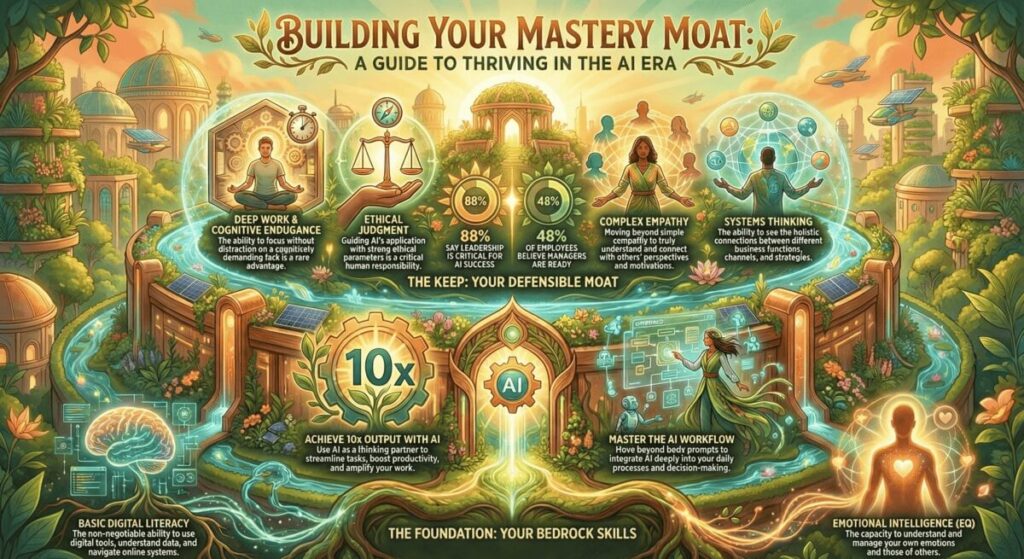
Think of the “Jagged Frontier” – that messy line where AI is brilliant at one task but hilariously bad at the next. To stay on the right side of that line, you need a Mastery Moat. This isn’t made of code; it’s made of what Coursera now calls “Power Skills.”
Surprisingly, Critical Thinking has jumped from 7th place to the #1 most in-demand skill. Why? Because when a machine can generate a thousand ideas in a second, the human who can tell you which one actually matters becomes the highest-paid person in the room. Your empathy, your ability to lead through a crisis, and your intuition are the only things AI can’t “unbundle.”
Your Degree Is a Wallet, but Your AQ Is the Cash
Here’s a truth that might sting: 4 in 10 core skills used today will be obsolete by 2030. In this environment, your university degree is essentially a nice leather wallet – it looks good, but it doesn’t tell us how much “currency” you actually have inside.

The new currency is your Adaptability Quotient (AQ). In 2026, we don’t care what you knew five years ago; we care how fast you can unlearn an old habit to make room for a better one. As Zig Ziglar famously noted: “Your attitude, not your aptitude, will determine your altitude.”
Teaching the Machines to Find You
(GEO is the new SEO)
For twenty years, we played the SEO game, trying to trick Google into showing our links to humans. That game is over. In 2026, we optimize for Generative Engines (GEO).
Thriving in 2026 isn’t about becoming a part-time programmer. It’s about doubling down on being more strategic, more adaptable, and more human.
- Look past the tools: AI is your “thinking partner,” not your replacement.
- Build the Moat: Focus on the “Power Skills” like leadership and critical thinking.
- Invest in AQ: Practice the art of being “permanently adaptable.”
Your Mini Quick Win for Today: Look at the Infographic below. It maps out the “Future Skills Matrix” for 2026. Pick one skill from the “Human-Centric” quadrant and commit 15 minutes today to reading one of the sources in our Recommended Reads section below.
The future isn’t a wave that’s going to crash over you—it’s a current you can learn to surf.
What’s your biggest “FOBO” (Fear of Being Obsolete) right now? Is it the tech, or the pace of change? Let’s talk about it in the comments!
Recommended Reads
Udemy 2026 Trends: The Rise of Adaptive Skills
WEF: The 2026 Skills Scarcity & The New Human Economy
Leave a Reply
You must be logged in to post a comment.